Limited liability
The company's debts are not automatically yours. Your house and savings stay yours if the work is sued.
Register a company in India
Register the company. Keep GST, books, and ROC on one calendar.
CA and CS on your file
Pricing upfront no surprises
AI-native ops
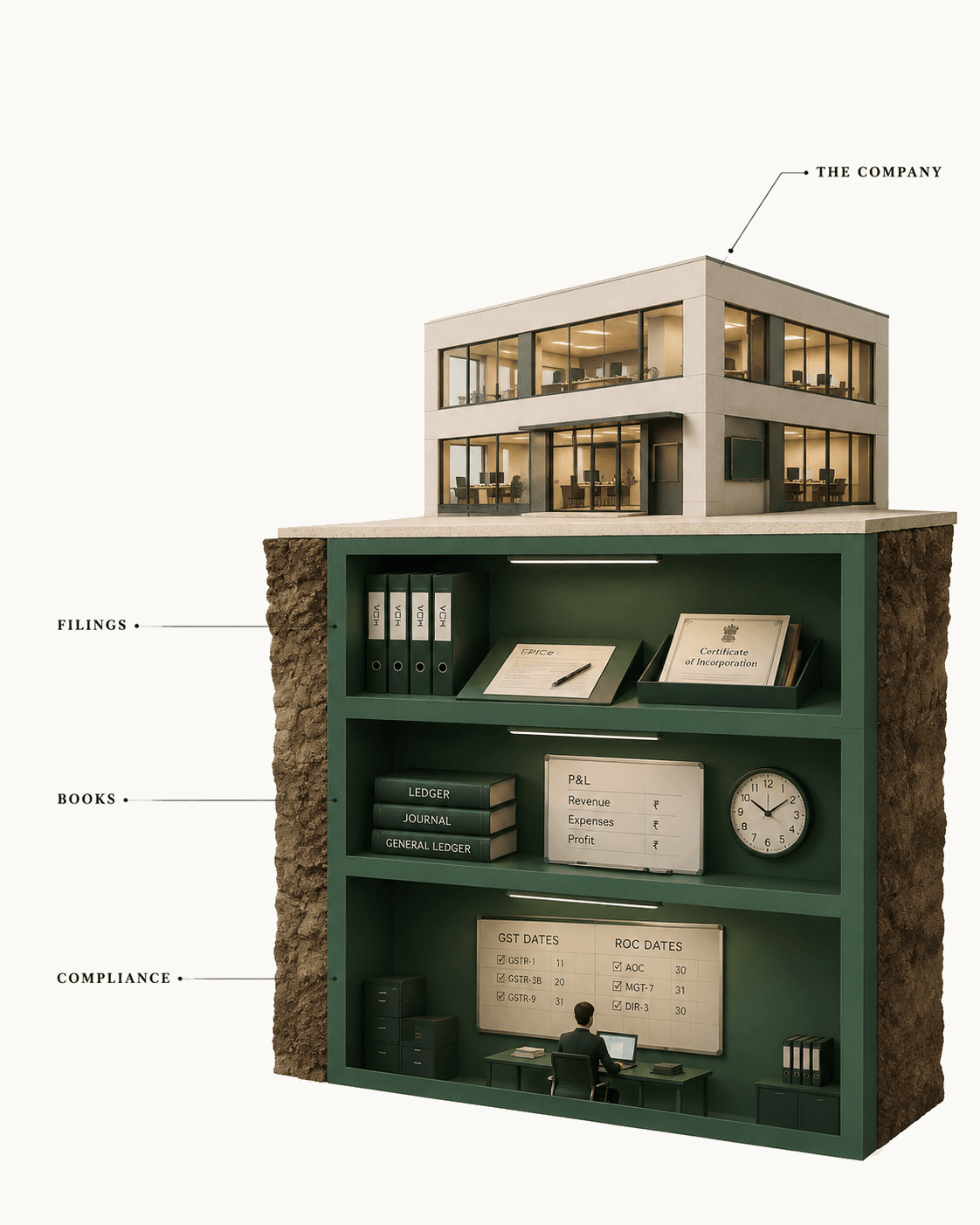
More than a registration.A foundation for what’s next.
Registration gives you limited liability, a CIN that banks and customers ask for, and a proper entity to sign contracts and issue shares. Picking Pvt Ltd, LLP, or OPC comes next.
Explore the three structuresThe company's debts are not automatically yours. Your house and savings stay yours if the work is sued.
Banks, marketplaces, and buyers ask for a CIN, the company's government ID, not a personal PAN.
If you take investment or issue ESOPs (employee stock), you will want a Private Limited. The other forms cannot issue shares.
The company signs, owns the IP, and sends the invoice. You are a director or partner, not the bill.
GST, invoices, and a ledger that belong to the company. Not a personal spreadsheet you hope the CA can read.
People can join or leave. The company stays. That is the point of a real entity, not a one-person invoice.
Is a registered company right for you?

Not sure yet?
Answer a few questions in onboarding: directors, state, and whether you might raise. Or read the three guides first.
How it works
Share a few details. We file with MCA. You get the certificate. Year one starts on one calendar, not a PDF in email and silence.
01
Structure, people, state, and capital. One screen at a time. We do not guess from the ad.
02
SPICe+ for a company, FiLLiP for an LLP. You review. We file with MCA.
03
CIN for a company, LLPIN for an LLP. Typically 7–12 working days once DSCs exist.
04
Books, GST, and ROC dates on a calendar while the certificate is incoming, if we file.
Structures
Pvt Ltd for equity. LLP for partners who will not raise. OPC for a solo founder with a nominee. If you already know, open that page. If not, read which one fits.
Still unsure? Compare structures

Pvt Ltd
Two directors, yearly audit, equity-ready. The form investors and ESOPs require.
Pick this if
You may raise, issue ESOPs, or want the form investors already know.

LLP
Two partners, limited liability, no audit until ₹40 lakh turnover. Cannot issue shares.
Pick this if
You have partners, will not raise, and want a cheaper run-rate.

OPC
One Indian citizen, one nominee, limited liability. Still a company, still a yearly audit.
Pick this if
It is just you, you are an Indian citizen, and you are not raising soon.
Pvt Ltd vs LLP vs OPC
All three give limited liability. The differences that matter are people, equity, and the yearly audit.
| Pvt Ltd | LLP | OPC | |
|---|---|---|---|
| People on day one | 2 directors, 2 shareholders | 2 partners, 2 designated partners | 1 member + a nominee |
| Equity / ESOP | Yes | No | Not until you convert |
| Statutory audit | Every year, any revenue | After ₹40 lakh turnover or ₹25 lakh contribution | Every year, any revenue |
| Incorporation form | SPICe+ | FiLLiP + Form 3 | SPICe+ with INC-3 |
| CompanyStack filing fee | ₹2,999 | ₹2,499 | ₹2,999 |
Start onboarding when you have a pick. If two rows still fit, we ask a few questions before the labelled slip.
Account in under a minute. Pick a structure, then the labelled slip before you pay.
What you pay
CompanyStack is fully transparent on pricing. MCA, stamp duty, and DSC are the same obligation with any provider—you pay them at challan, and we do not mark them up. Our filing fee sits on its own line during onboarding, so nothing new appears at year-end.
Not bundled into our fee. What MCA, your state, and the certifying authority charge is what you pay.
Pvt Ltd and OPC. ₹2,499 on LLP. The only line that is ours, shown before you commit.
GST applies to our line, not to government collections. You see the split once and it stays that way.
State and capital change the government total. They do not change our rule: one clear CompanyStack line, always visible.
Account in under a minute. Pick a structure, then the labelled slip before you pay.

What comes next
Registration gives you a CIN or LLPIN. Commencement filings, GST, books, and annual ROC are what keep the entity in good standing.
Certificate lands
If we filed, books and ROC dates are already on a screen. You are not waiting for a PDF in email.
Within 180 days
A Private Limited or OPC with share capital must tell MCA it has started. LLP skips this form. Cheap shops rarely put either on a calendar.
When clients ask
Marketplaces and larger buyers want a GSTIN. Books should already be open, not a new vendor.
Every year
Pvt Ltd and OPC audit every year, any revenue. LLP waits for a turnover trigger. The dates do not care.
If you will raise or issue ESOPs, private limited: the only form that issues shares an investor can hold. If you will not raise, an LLP (two people) or an OPC (one person) is usually enough, and cheaper to run.
Pvt Ltd: equity, ESOP, yearly audit at any revenue, two people. LLP: partners, no equity, audit only after a trigger, two people. OPC: one person, no equity until conversion, yearly audit, a nominee.
You can invoice on a personal PAN until a bank, marketplace, or GST requires a form. If you want limited liability, shares, or a CIN, pick Pvt Ltd, LLP, or OPC and start onboarding.
Typical two-director Pvt Ltd at ₹1 lakh capital: ₹1,000 MCA name fee, nil SPICe+ filing, state stamp duty, ₹3,000 DSC, ₹2,999 CompanyStack (waived on a 12-month plan). LLP swaps SPICe+ for FiLLiP slabs and a ₹2,499 filing fee. Government and DSC stay at cost on every path.
About 7 to 12 working days for an Indian-director SPICe+ or a straightforward FiLLiP, once DSCs exist. MCA review is not our clock. Foreign papers add apostille time.
You need a registered office address in India where government post can arrive. A home or a real co-working desk works if the utility bill and the owner's NOC are real. A rented CIN address in a cheap stamp-duty state, with no presence there, is how people fail INC-22 later.
Government and DSC are at cost wherever you go. The number that moves is the professional fee. Ours is ₹2,499–₹2,999 for that work, waived if you take a year of the workspace.
Ready to build?
Pick a structure, see a labelled slip, and start year one on one calendar.
No card until you approve the slip. Government and DSC stay at cost.
Account in under a minute. Pick a structure, then the labelled slip before you pay.